Signature Products, Unmatched Quality


Leave Your Message
Signature Products, Unmatched Quality


Choosing a Zinc Alloy Drawer Lock in 2026 requires more than comparing prices and polished finishes. A lock may look strong on a showroom display. Its daily performance depends on alloy quality, cylinder design, cam alignment, and installation accuracy. Zinc alloy offers useful casting flexibility and corrosion resistance. However, poor casting can create weak threads, rough edges, or inconsistent key movement.
Michael H. S. Lee, a veteran cabinet-hardware consultant, says, “A drawer lock is only dependable when its material, mechanism, and installation work together.” That principle deserves attention. A heavy-looking body does not automatically indicate durable zinc alloy. Buyers should request material details, dimensional drawings, load information, and practical test evidence. Supplier reputation matters too. Certifications can help, but they should not replace physical inspection.
This guide examines the details that are easy to overlook. We will compare lock body thickness, cylinder options, cam reach, key control, finish durability, and fitting tolerance. We will also consider humid offices, retail counters, workshops, and home furniture. A lock that performs well in a dry showroom may struggle beside a kitchen sink. That is an uncomfortable possibility. It is also why product selection should include real usage conditions.
Some decisions remain imperfect. A lower-cost lock may suit light drawers, while a premium model may be unnecessary for occasional use. The right Zinc Alloy Drawer Lock balances security, service life, appearance, and installation effort. Careful evidence beats attractive packaging.
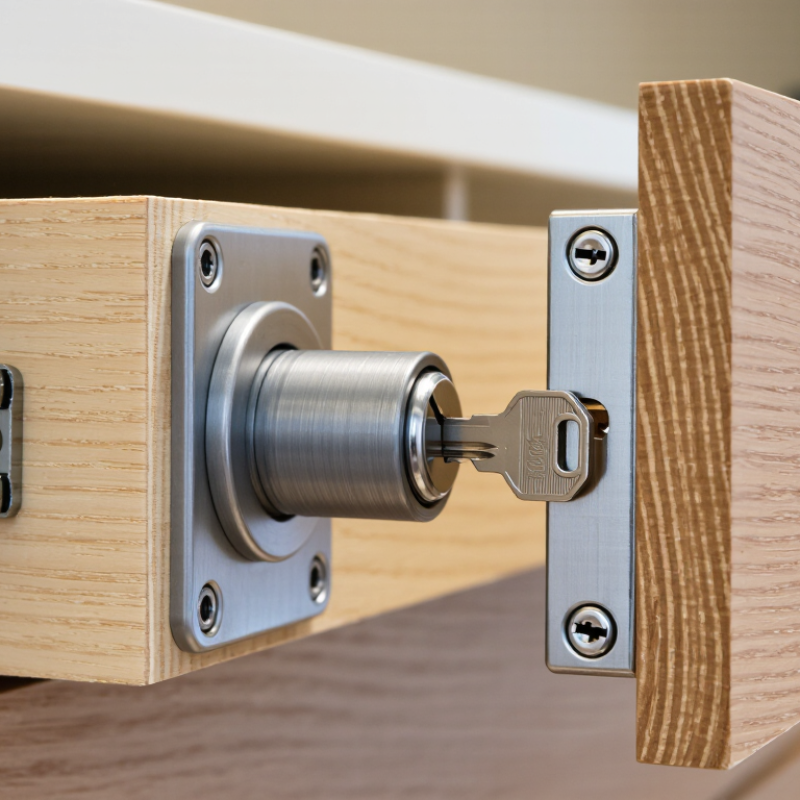
A zinc alloy drawer lock is a compact security fitting made from zinc-based metal. It usually includes a lock body, a cylinder, a cam, and one or more keys. The cylinder receives the key. When the key turns, internal pins or wafers align, allowing the cam to rotate behind the drawer panel. That cam catches the cabinet frame and keeps the drawer closed.
In practical use, the lock’s size matters more than its appearance. Measure the panel thickness, hole diameter, and available clearance behind the drawer. A cylinder that is too long may hit the drawer contents. A short cam may fail to reach the frame. Zinc alloy offers useful strength, light weight, and a smooth plated surface. However, it is not automatically corrosion-proof. Moisture, cleaning chemicals, and rough handling can damage the finish over time.
When choosing one in 2026, check the cam shape, key rotation angle, fixing nut, and stated load limits. A lock should fit firmly without crushing thin wood or sheet metal. I once fitted a visually neat lock with an unsuitable cam; it turned smoothly but barely held the drawer. That mistake was avoidable. Test the lock with the drawer loaded, not empty. Inspect the key movement, mounting stability, and alignment after several openings. A trusted specification should explain materials, dimensions, testing conditions, and replacement key options clearly. Fancy plating is not proof of dependable performance.
| Evaluation Dimension | Typical Data or Option | What It Means | Recommended Selection Guidance |
|---|---|---|---|
| Material | Zinc alloy, commonly die-cast | Provides a rigid lock body with good casting efficiency and a smooth surface for plating or coating. | Choose zinc alloy for indoor furniture, office cabinets, drawers, mailboxes, and light-to-medium duty enclosures. |
| Basic Working Principle | Key-operated cylinder rotates a cam or bolt | Turning the correct key aligns the internal mechanism and moves the locking cam or bolt between locked and unlocked positions. | Confirm that the cam movement and rotation direction match the drawer and cabinet design. |
| Common Lock Format | Cam lock, plunger lock, push lock, or tubular-style lock | Different formats use different locking movements and installation methods. | Use a cam lock for general drawers; select a push or plunger design when quick operation or a flush appearance is important. |
| Typical Panel Thickness | Approximately 0.8–3.0 mm for many cabinet-lock installations | The lock body and threaded fixing nut must securely fit the drawer front or cabinet panel. | Measure the actual panel before ordering; use a suitable barrel length or spacer for thicker panels. |
| Installation Hole | Often about 16–22 mm, depending on the lock design | The required hole diameter is determined by the lock barrel and mounting flange. | Match the product drawing to the existing hole; do not rely only on the external face diameter. |
| Locking Movement | Commonly a quarter-turn or half-turn cam rotation | The cam rotates behind the cabinet frame or drawer structure to prevent opening. | Verify the required rotation angle, cam shape, and offset for proper engagement. |
| Keying Arrangement | Keyed differently or keyed alike | Keyed-different locks use separate key patterns; keyed-alike locks can be operated by the same key. | Choose keyed alike for multiple drawers managed by one user and keyed different for basic separation of access. |
| Surface Finish | Nickel, chrome, black, zinc-colored, or other plated/coated finishes | The finish influences appearance and provides an additional barrier against ordinary handling and indoor humidity. | Select a finish compatible with the furniture and avoid assuming decorative plating is equivalent to outdoor corrosion protection. |
| Corrosion Environment | Best suited to dry or normally ventilated indoor environments | Zinc alloy and its finish can be affected by salt spray, persistent moisture, chemicals, and abrasive conditions. | For kitchens, bathrooms, coastal locations, or outdoor use, verify the finish and corrosion-test data before purchase. |
| Security Level | Basic deterrence for furniture and light-duty storage | A drawer lock helps restrict casual access but is not normally a substitute for a high-security safe or certified access-control lock. | Use a stronger, independently tested security solution when protecting high-value items or meeting regulatory requirements. |
| Load and Misalignment Tolerance | Designed for correctly aligned, lightly loaded drawers | Excessive drawer load or frame misalignment can place side pressure on the cam and make the key difficult to turn. | Check drawer alignment, clearance, and closing force before selecting a lock for heavily used storage. |
| Temperature Consideration | Suitable for ordinary indoor temperature ranges unless otherwise specified | Extreme heat, cold, or rapid temperature changes may affect lubricants, tolerances, and finish durability. | Request application temperature data for industrial, refrigerated, heated, or exposed installations. |
| Maintenance | Periodic cleaning and light lock lubricant when required | Dust, debris, and unsuitable oils can increase friction or attract contaminants inside the cylinder. | Keep the keyway clean, avoid forcing the key, and follow the lock manufacturer’s lubricant instructions. |
| Best Application | Office pedestals, wooden drawers, metal cabinets, display cases, and storage compartments | These applications generally require compact dimensions, simple operation, and moderate access control. | Select the lock according to panel material, drawer geometry, usage frequency, and required level of access control. |
Note: Dimensions and performance ranges are typical industry values. Always confirm the technical drawing, installation dimensions, finish specification, and application conditions for the exact lock model.